
I am not trying to be Shakespeare with that title, but let me tell you a true story. I recently visited a client's home — something I make a point of doing at the start of every project, ideally during the proposal phase or feasibility study. Their plan was to short-plat their 10,000-plus square foot property into two parcels, as allowed under the jurisdiction's new middle housing regulations, and build a new single-family residence on the newly created lot.
I wasn't the first architect they had hired. A previous firm had already taken the design to 75% permit drawings before the homeowners decided to part ways with them, citing a persistent lack of communication and responsiveness. At that point, the short plat existed only as a sketch on paper — it had never been submitted for city review, let alone approved.
This was a classic case of architectural design getting far ahead of site design.
The 18-Foot Surprise
As we sat down to review the previous firm's drawings, I glanced out the window and noticed something that didn't add up. "That fence looks a lot closer to your house than it should be. Have you noticed that before?" I pulled out the survey. The fence was shown on it, but it wasn't sitting on the property line — not even close. It encroached into my client's property by as much as 17 feet.
"How long has it been there? More than 20 years? Do you realize this could be grounds for an adverse possession claim?" The questions came out before I even looked closely at the previous drawings. When I did, I found they had placed the proposed new house squarely on top of the fence line. How had no one caught this? How had no one noticed a fence that could hand the neighbor a legal claim to a slice of my client's land?
"They never visited the site," the client told me.
I was dumbfounded.
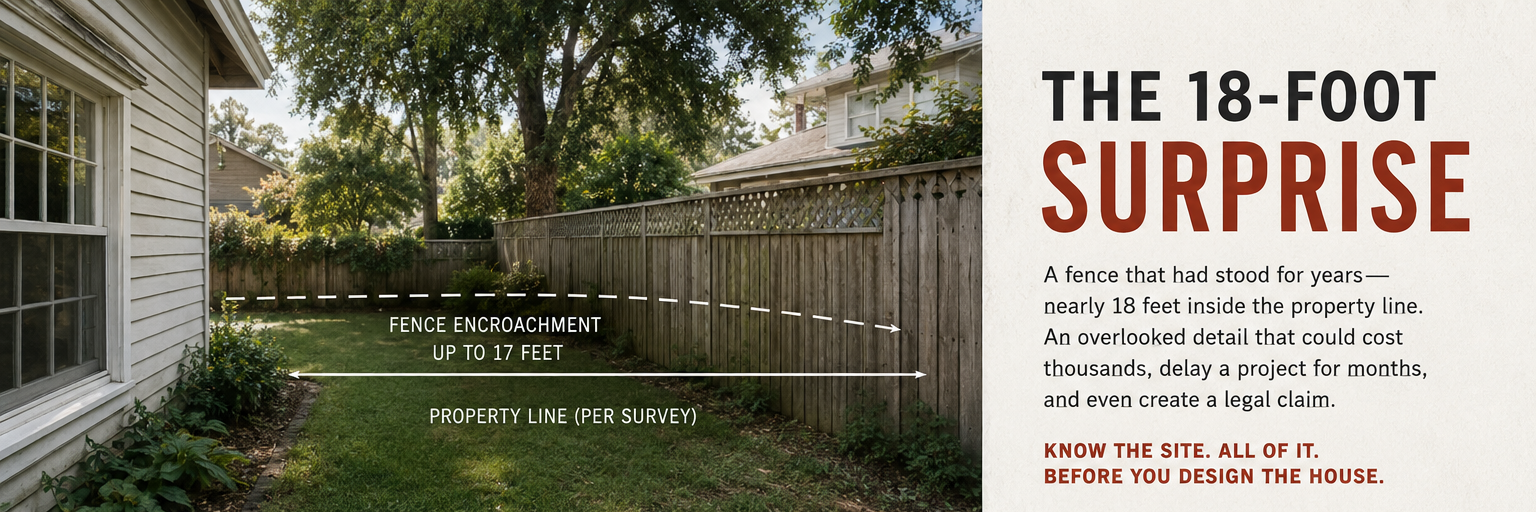
The neighbor’s fence encroaches onto the client’s property by 17ft.
The Golden Rule of Architecture
It's not a written rule, but from Day One of studying architecture through every day of my career, I've held one belief firmly: an architect must know the site. Walk it — more than once. Photograph it from every angle. Fly a drone to capture what you can't see from the ground, and to understand what views upper stories might open up or foreclose. Know it the way you'd know a place you've lived in. Because the site is one of the three foundational forces that shape any architectural design. (The other two are societal and cultural context, and the client's specific program and vision — topics I'll address in separate posts.)
I'm not telling this story to position myself above the previous architects. The point is simpler and more universal: site is easy to overlook, and the consequences of overlooking it can be severe. In this case, my client had to discard everything the previous firm produced and rethink the entire development strategy — pivoting from a single-family residence to a pair of cottages, with a new set of design constraints and entitlement risks to navigate.
I don't remember exactly who said it, but I'm certain at least one of my professors at the GSD put it something like this: design the site before you design the building. Over the course of my career, those words have become a kind of professional north star. The terrain, the solar orientation, the sequence of arrival, the vegetation, the drainage patterns, the neighbors, the privacy dynamics — all of it must be understood before a single floor plan takes shape.
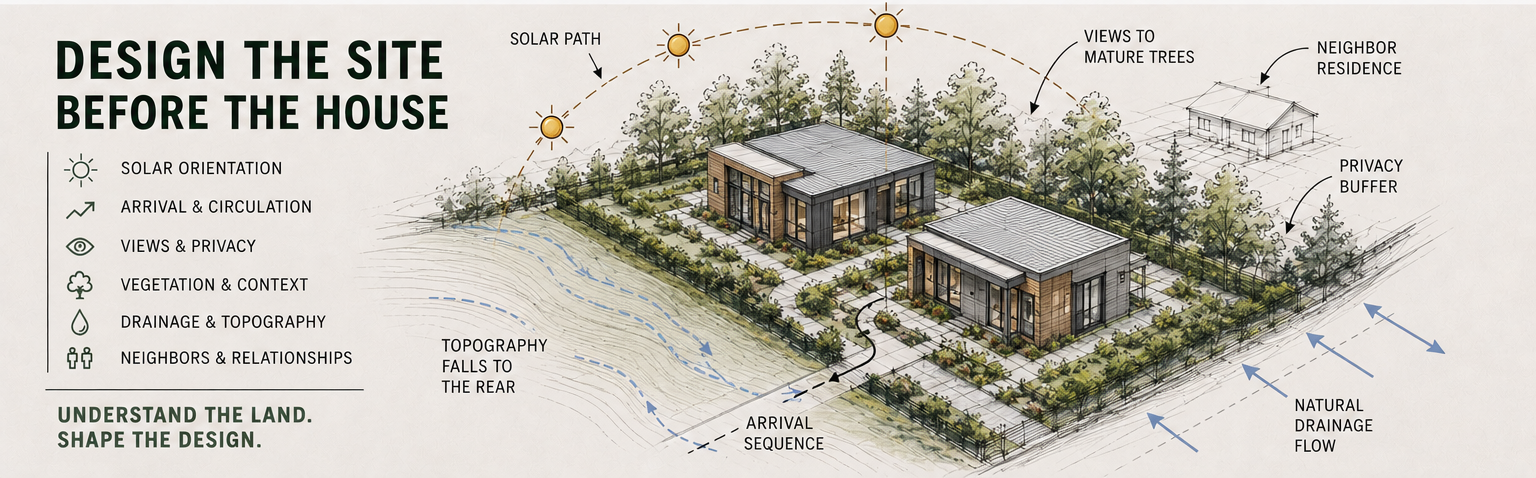
The six elements of site design
Every site has a story to tell, long before a shovel ever hits the ground. When you ignore the land, the land has a funny way of pushing back—sometimes to the tune of thousands of wasted dollars and months of delays.
Whether it’s a conceptual project like the Martha’s Vineyard Art Center I designed at GSD, or a real-world development like my Shoreline Townhouse project (both of which you can read about in my other blog posts), the philosophy remains the same.
Site isn't a constraint to work around. It's the foundation everything else is built on — literally and conceptually. A building imposed onto a site will always feel forced. A building shaped by its site feels inevitable.
That is why architects should design the site before they design the house. Because when the site is understood deeply and honestly, the architecture has a chance to become something far more enduring than an object placed on land — it becomes part of the land itself.