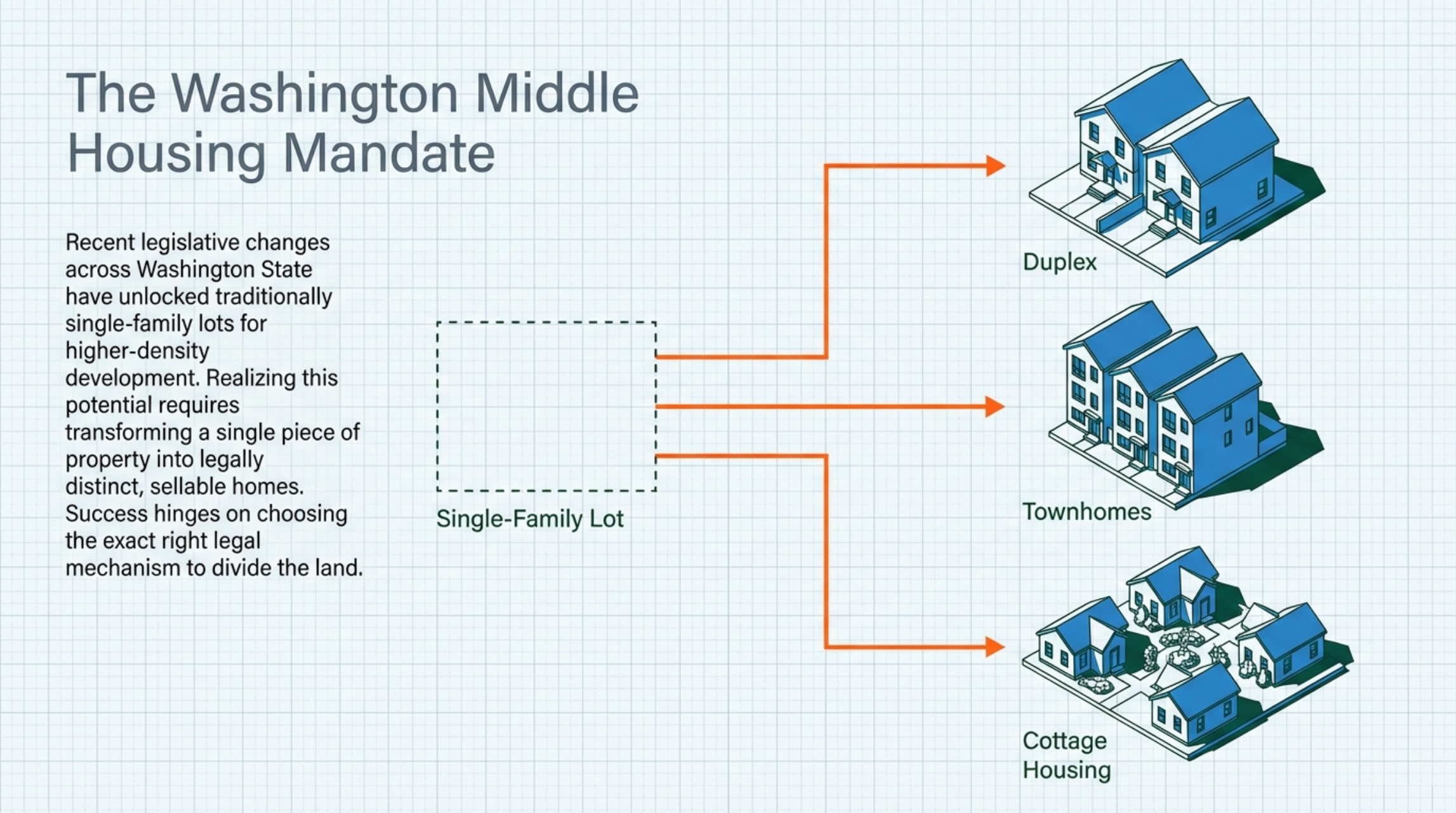
Given the recent implementation of Middle Housing laws in Washington State, one of the most common questions I receive from clients is about land subdivision. With new opportunities to build duplexes, townhomes, and cottages on traditionally single-family lots, understanding how to legally divide your land is more important than ever. In this blog, I’ll lay out the typical roadmap to help you navigate this process.
There are three main types of land subdivisions: the long plat, the short plat, and the unit lot subdivision. I will focus on the short plat and unit lot subdivisions, as these are the most common avenues for small-to-medium-sized land development in the Greater Seattle area. I will also touch on an increasingly popular alternative to land subdivision—condominiumization—at the end of this post.
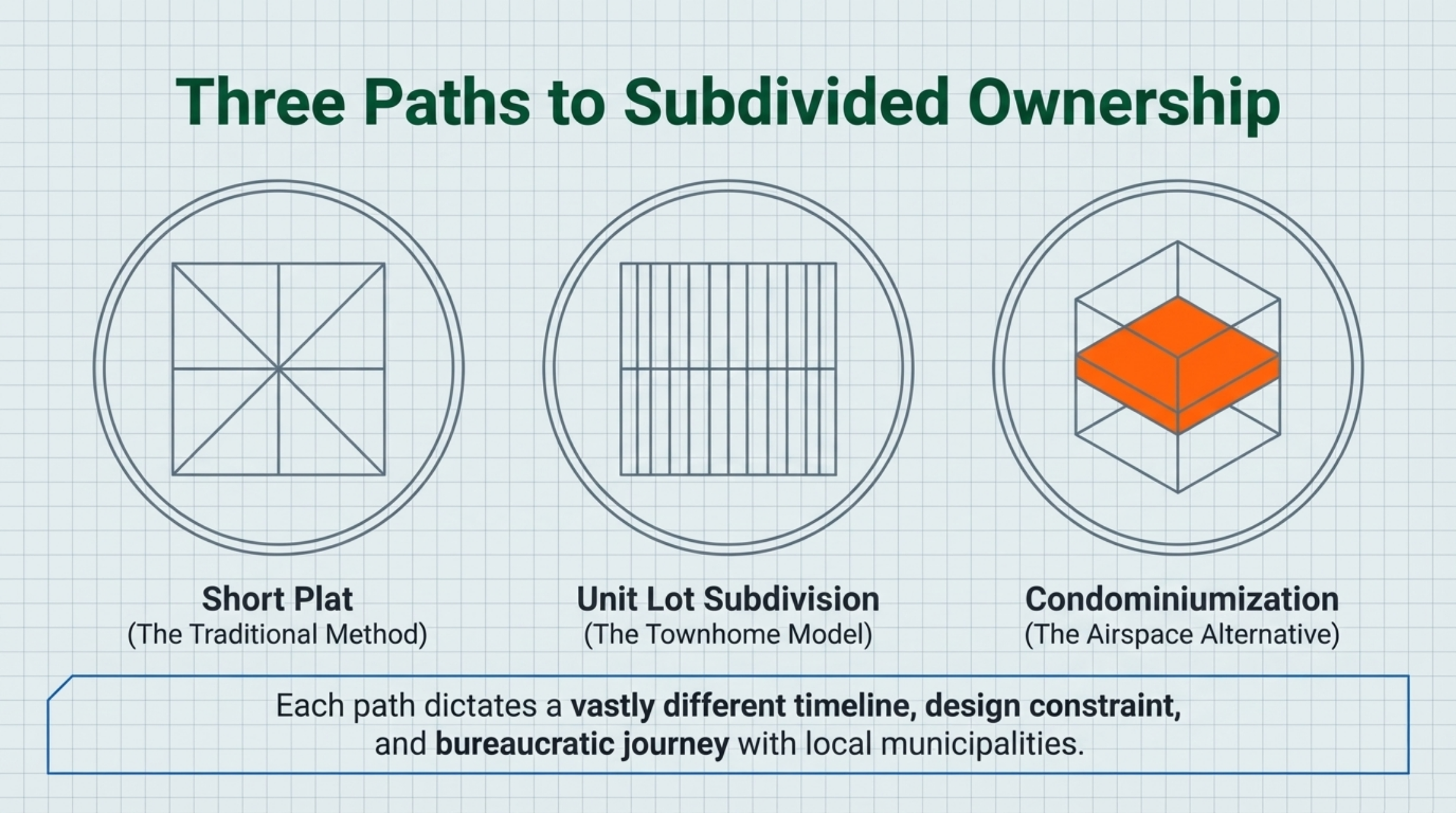
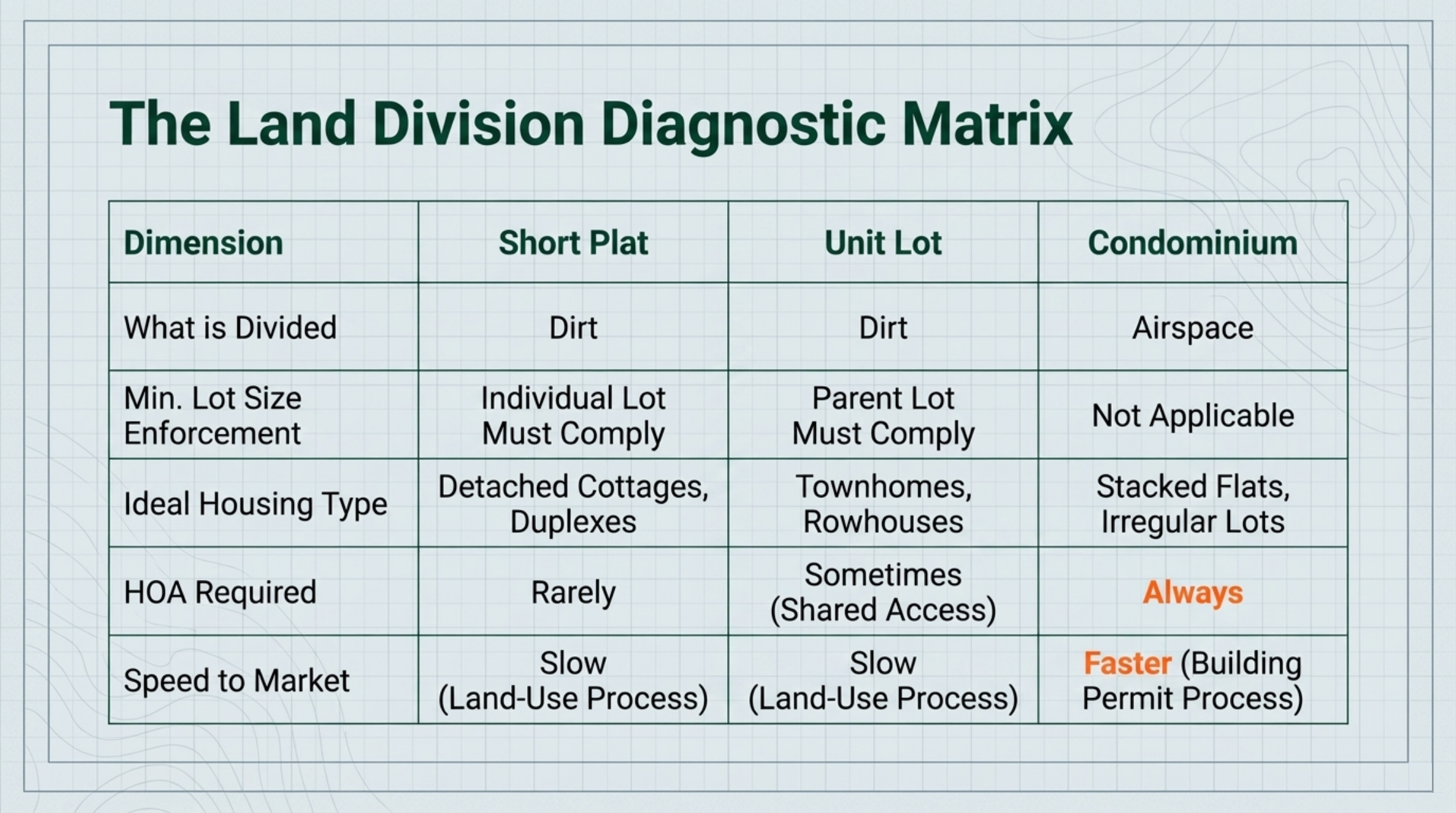
Before diving into the steps, it helps to understand the difference between your two main options:
Short Plat: The traditional method of dividing a property into a smaller number of lots (often up to 4 or 9, depending on the city). Each new lot must independently meet the zone’s minimum size and width requirements.
Unit Lot Subdivision: Tailored specifically for housing types like townhomes, rowhouses, or cottage housing. The original "parent" lot must meet the zoning requirements, but the individual "unit" lots created for each home do not. This allows for fee-simple ownership of high-density middle housing.
No matter which path you take, the subdivision process generally includes two major stages: the Preliminary stage and the Final stage, alongside the building permit application process. While every jurisdiction (Seattle, Bellevue, Kirkland etc.) has slightly different codes, the following is the most common process you will encounter.
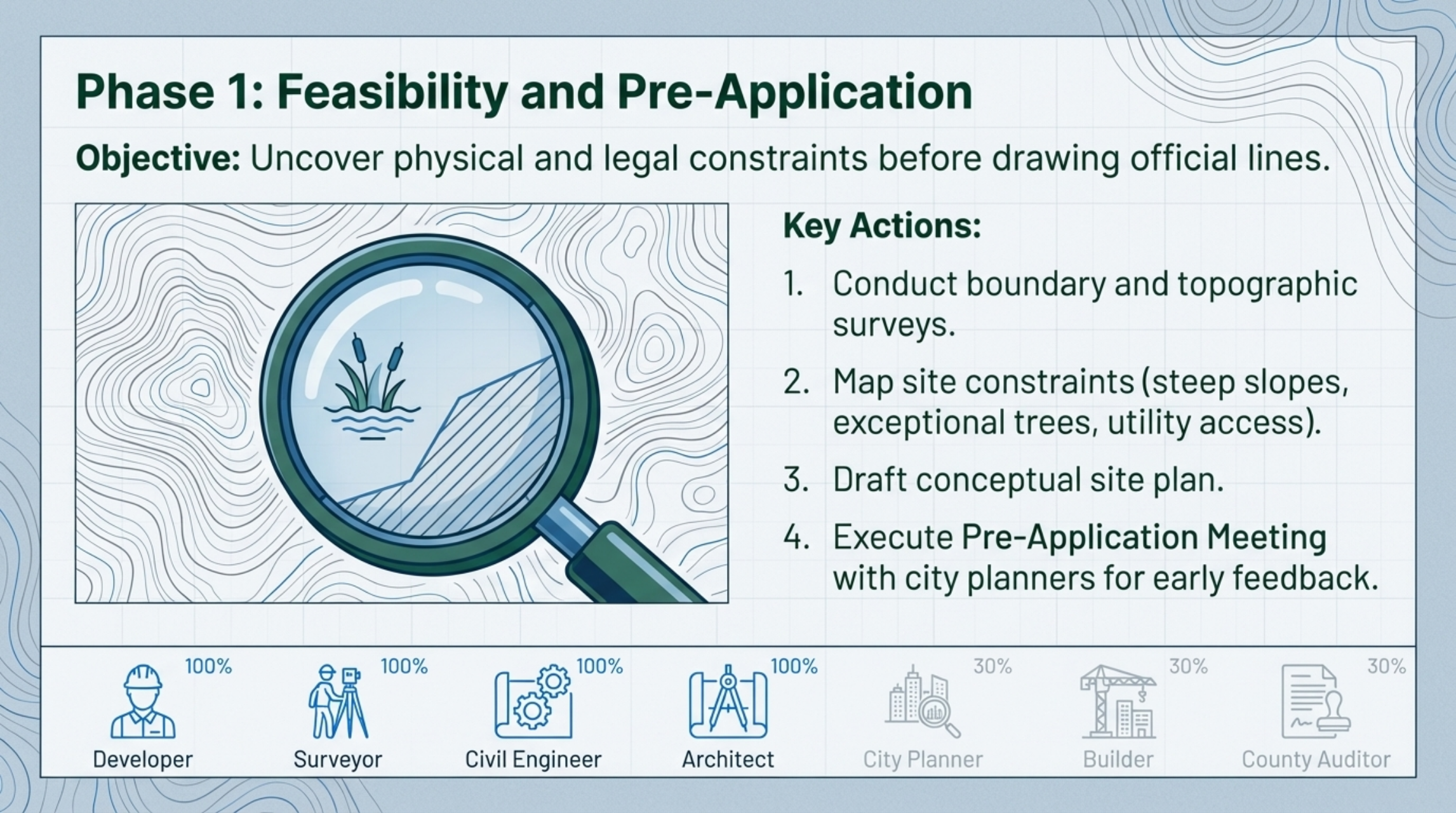
Phase 1: Feasibility and Pre-Application
Before drawing any official lines, you need to know exactly what is legally and physically possible on your site. During this phase, you will uncover any site constraints like steep slopes, wetlands, exceptional trees, or limited utility access.
What needs to be done: Conducting a boundary and topographic survey, researching local zoning codes, mapping out a conceptual site plan, and often scheduling a "Pre-Application Meeting" with the city to get early feedback from local planners.
Who is involved: You (the developer/owner), a Land Surveyor, a Civil Engineer, and an Architect or Land Use Planner. City staff will be involved if a pre-application meeting is held.
Phase 2: The Preliminary Subdivision (Design & Approval)
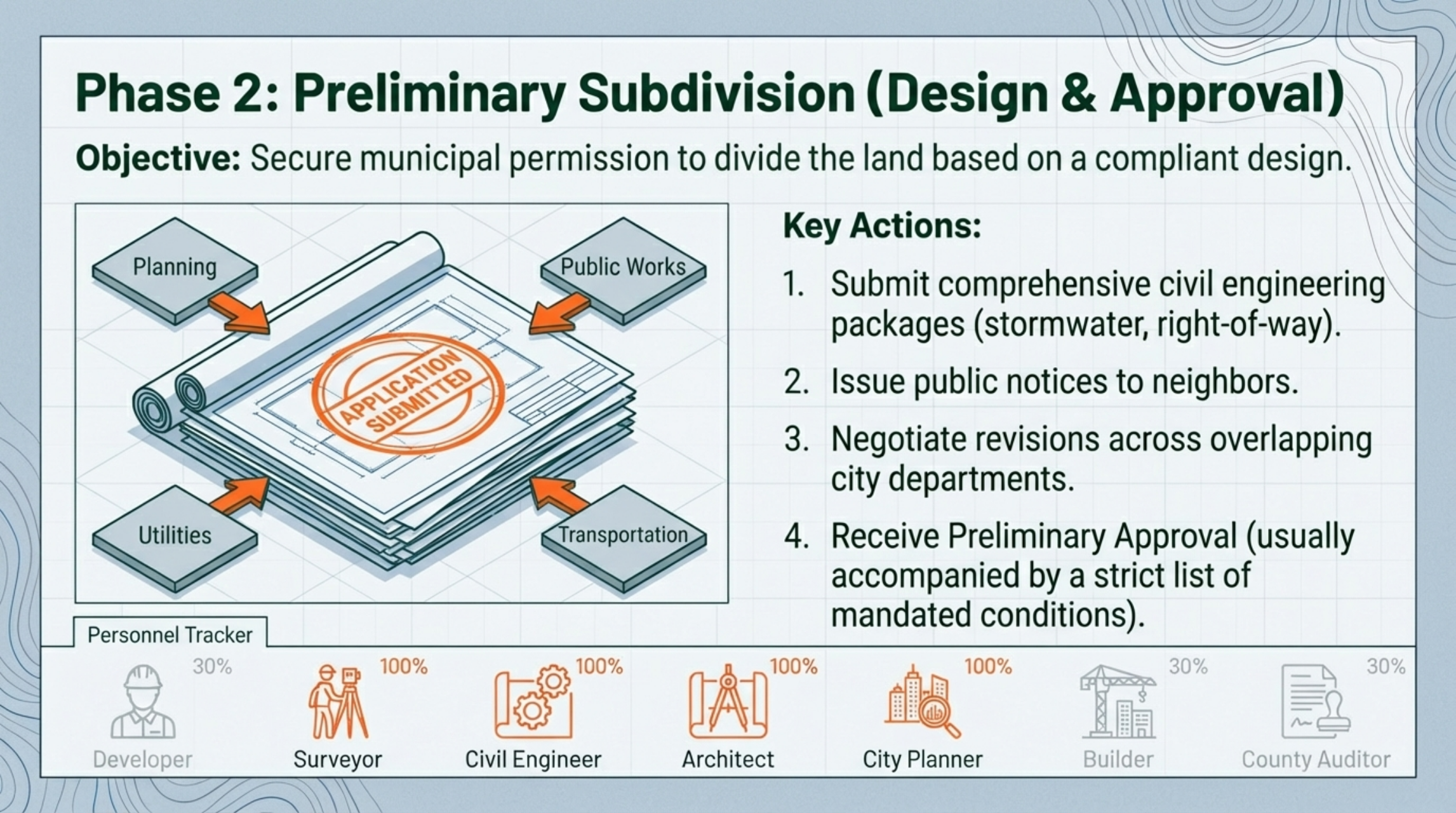
This is the heavy lifting phase where the city reviews your proposed division to ensure it complies with all development codes. You are essentially asking the city for permission to divide the land based on your proposed design.
What needs to be done: Submitting a comprehensive application package that includes civil engineering plans (showing stormwater management, utility connections, and right-of-way improvements), tree retention plans, and the preliminary plat map. The city will review this, often require public notice to neighbors, and eventually issue a "Preliminary Approval," which usually comes with a list of conditions you must meet before the final plat is approved.
Who is involved: Your design team (Architect, Civil Engineer, Surveyor, Landscape Architect) and various city departments (Planning, Public Works, Utilities, and Transportation).
Phase 3: Civil Construction & Building Permits (The Concurrent Approach)
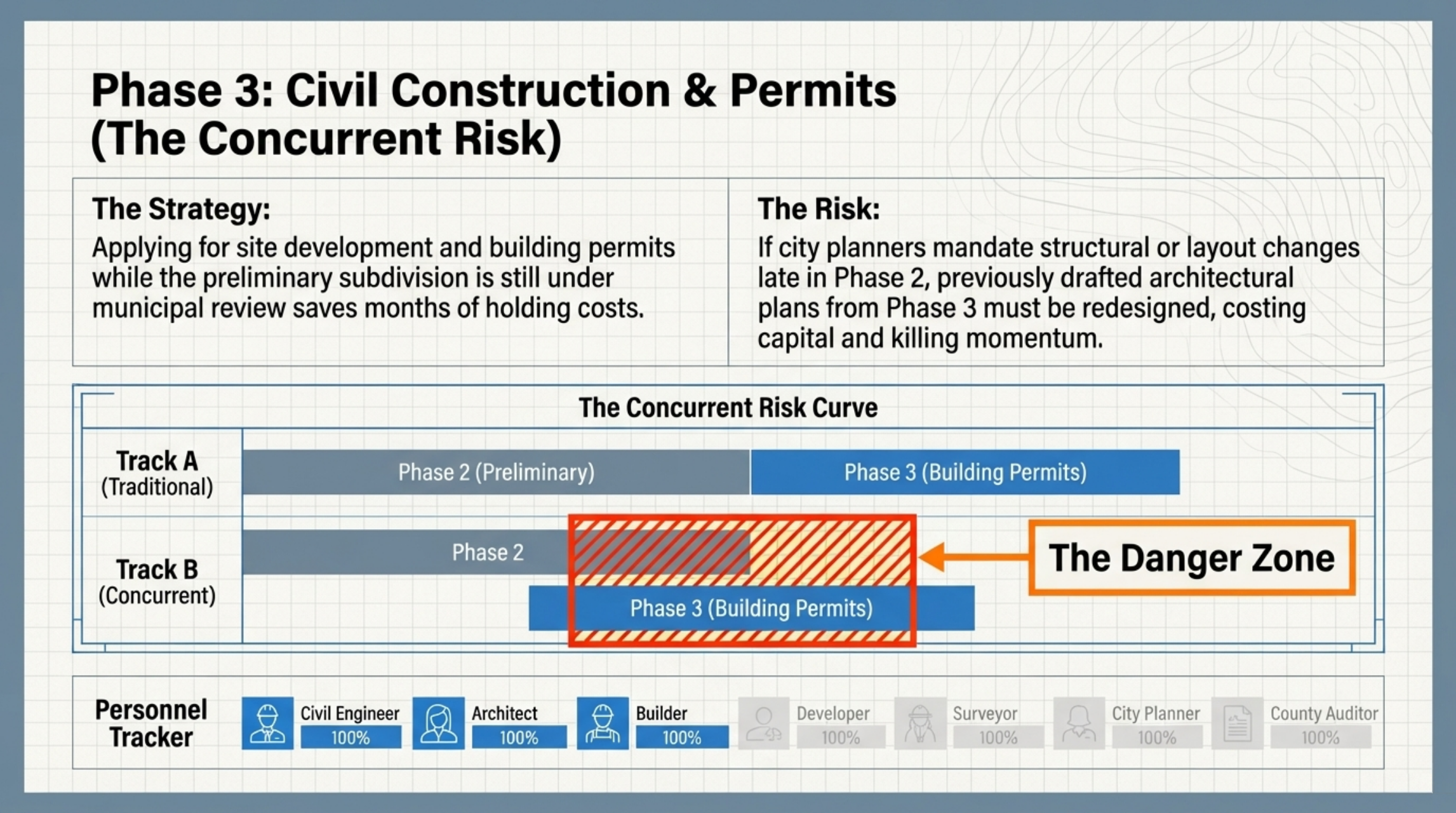
Traditionally, you had to wait for your Preliminary Subdivision to be completely approved before applying for building permits or starting site work. However, many jurisdictions now allow a concurrent approach. This means you can apply for your site development and building permits while the preliminary subdivision is still being reviewed.
What needs to be done: Finalizing the architectural and structural design of the homes, securing building permits, and performing the actual physical work on the site—grading, installing sewer and water lines, pouring foundations, and building the structures.
Who is involved: General Contractor, Subcontractors, Architect, Civil Engineer, and City Building Inspectors.
Note: The concurrent approach saves a tremendous amount of time but carries some risk. If the city requires changes to your subdivision layout during Phase 2, you may have to revise your building plans to match.
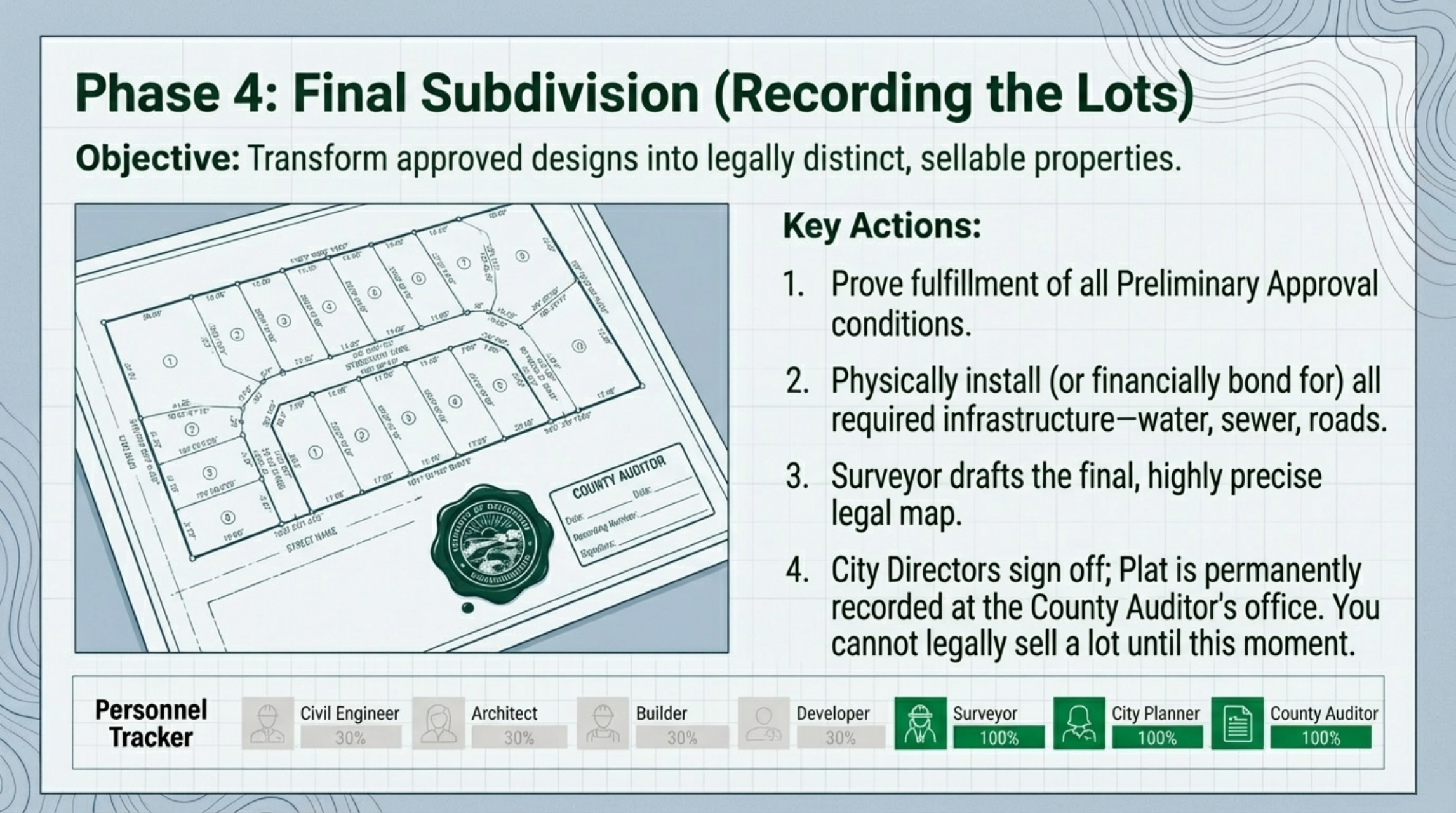
Phase 4: Final Subdivision (Recording the Lots)
You cannot legally sell the newly created lots until the Final Plat is recorded with the county.
What needs to be done: Proving to the city that you have met all the conditions outlined in the Preliminary Approval. This usually means that all infrastructure (water, sewer, roads, stormwater systems) is physically installed and inspected, or bonded for. Once the city approves the Final Plat, it is routed for official signatures and recorded at the County Auditor’s office.
Who is involved: Land Surveyor (to draft the final, highly precise legal map), City Planners, City Directors or Council (for final sign-off), and the County Recording Office.
An Alternative: Condominiumization
What if your site doesn't quite fit the rigid rules of a short plat or a unit lot subdivision? This is where condominiumization comes in.
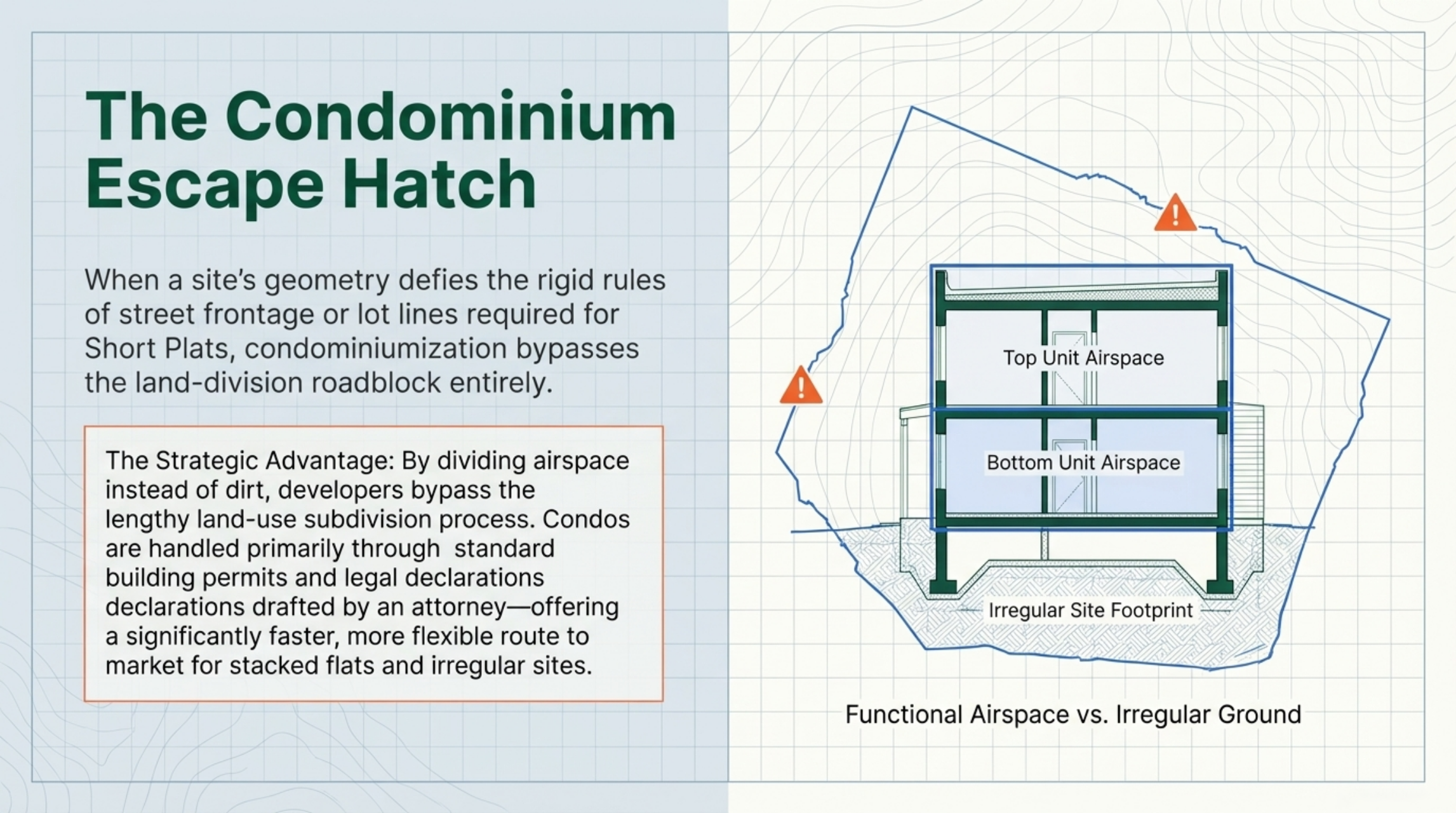
Unlike a subdivision, which draws new property lines in the dirt, a condominium divides the airspace. When you build a condo, the land and the exterior of the buildings are typically owned jointly by an active Homeowners Association (HOA), while the buyer owns the space within the walls of their specific unit.
Why choose this route? Condominiumization is highly flexible. It is frequently used for stacked flats (like a duplex where one unit is above the other) or on oddly shaped lots where standard subdivision rules regarding street frontage or lot lines are impossible to meet. In many jurisdictions, creating a condo does not require a lengthy land-use subdivision process; instead, it is handled primarily through building permits and drafting legal declarations with an attorney. While it requires setting up an HOA, it can often be a faster route to getting homes to market.
The Bottom Line Unlocking the potential of Middle Housing on your property is a highly rewarding venture, but it requires patience and the right team. Whether you pursue a short plat, a unit lot subdivision, or a condominium, understanding these phases early on will help you budget your time, manage your risks, and successfully navigate the Greater Seattle development landscape.
If you are considering a land development project or want to explore what is possible on your property, Darren Vinci Studio can help. We specialize in navigating local zoning codes and designing thoughtful, context-driven residential architecture tailored to the Pacific Northwest. Reach out to schedule a feasibility study and take the first step toward turning your property’s potential into reality.