
This is a story about bringing a seemingly dead project back to life.
The ingredients were simple, but not easy: a healthy amount of indignation, a bit of good luck, and a tectonic shift in Washington State’s housing policy.
The Beginning: A Tight Site, A Clear Vision
In early 2024, I was commissioned to design a townhouse development on a 0.14-acre parcel on the Shoreline side of NE 145th Street. At the time, the site was zoned R48. By calculation, 0.14 × 48 yielded a theoretical maximum of seven units.
But theory and physical reality are rarely aligned.
After carefully studying the surrounding buildings, site constraints, and solar access, I developed a design that responded to both the urban fabric and natural context. The outcome was a highly efficient townhouse type only 15 feet wide — compact, but met the demand of a certain segment of the market.
This unit width allowed:
Two units along the front facing the street
A 15-foot driveway between them
Three units along the rear
Five units total — not the theoretical seven, but the best achievable configuration given real-world constraints.
The design was disciplined, contextual, and economically viable. The client was pleased. I submitted the project for a pre-application meeting in July 2024.
That’s when everything went south.
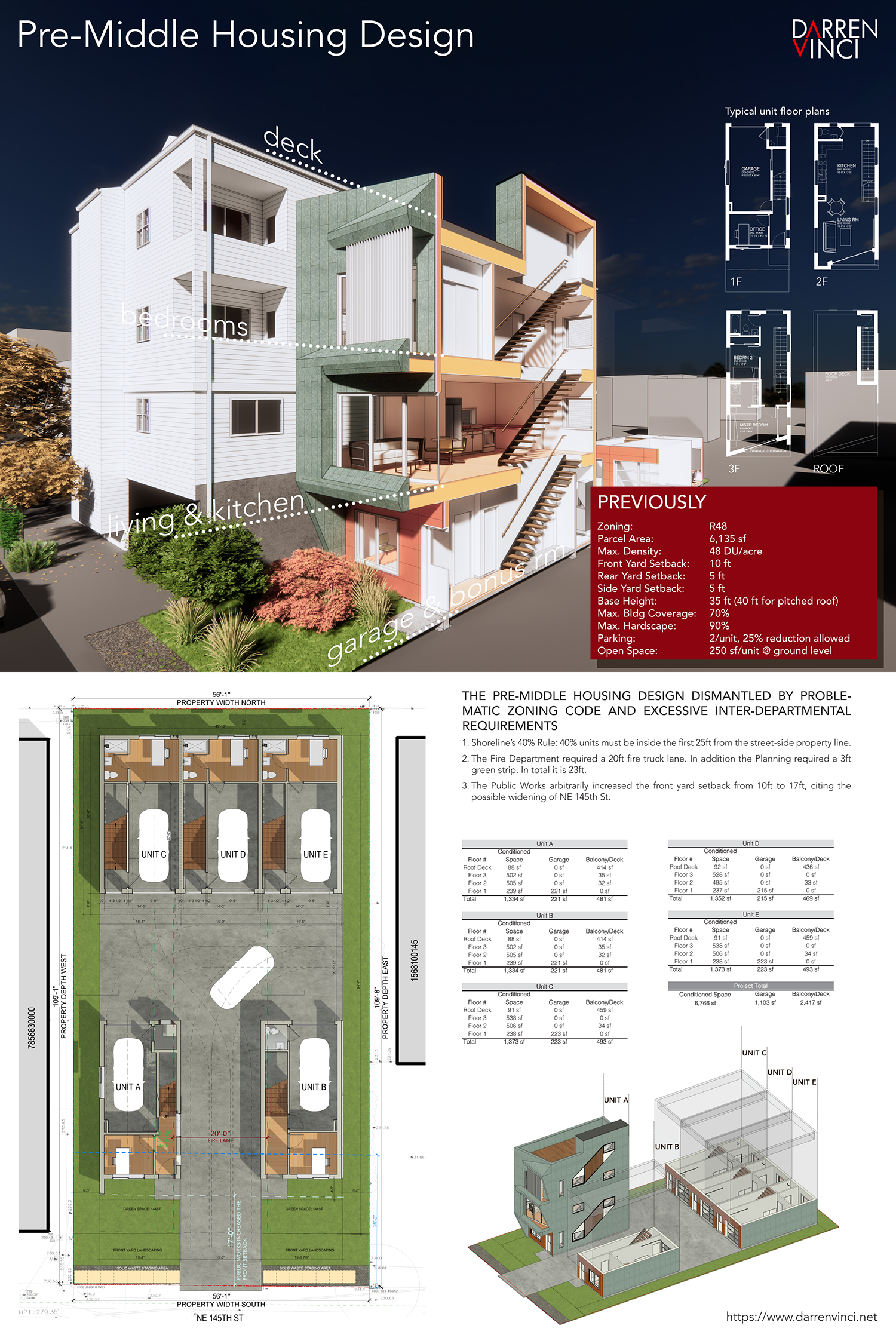
The July 2024 Design that was dismantled by the then Shoreline zoning code and excessive inter-departmental restrictions
The Collision with Regulation
During the pre-application meeting, multiple departments introduced requirements that, taken together, made the project physically impossible.
Here is what we were told:
1. Fire Access Width
The Fire Department demanded a 20-foot driveway instead of the 15-foot for fire access. Planning then required an additional 3-foot landscaping strip alongside it — resulting in a 23-foot-wide access lane.
At the same time, Shoreline had a “40% rule” for townhouses: 40% of units must be located within the first 25 feet from the front property line. My original 15-foot driveway made that possible. A 23-foot driveway made it impossible.
2. Front Setback Expansion
Although zoning required a 10-foot front setback, Public Works demanded 17 feet, citing the “possible” future addition of a left-turn lane and road widening.
3. Parking Requirements
Two parking spaces per unit were required. Being within ¼ mile of the BRT station reduced this by 25%, but we still needed six parking spaces.
4. Ground-Level Open Space
The code required 250 square feet of ground-level open space per unit.
Individually, these requirements were manageable. Together, they rendered townhouse development infeasible. The only buildable option would have been a duplex or a single house with ADUs — far below the site’s highest and best use.
At that point, we had invested over half a year in design. The client had committed tens of thousands of dollars in professional fees. And yet the project was effectively dead.
That was not acceptable.
Speaking Up
In September 2024, I attended a Shoreline Planning Commission meeting and spoke during public comment.
I presented the project and laid out the contradiction plainly: If the Fire and Planning Departments carve out a 23-foot north-south driveway, and Public Works imposes a 17-foot east-west setback, how can 40% of the units physically fit within the first 25 feet of the site?
It was not an abstract complaint. It was geometry.
The room grew noticeably quieter after the presentation.
After the meeting, the Director of Planning and Community Development approached me and invited further discussion. That conversation proved pivotal.
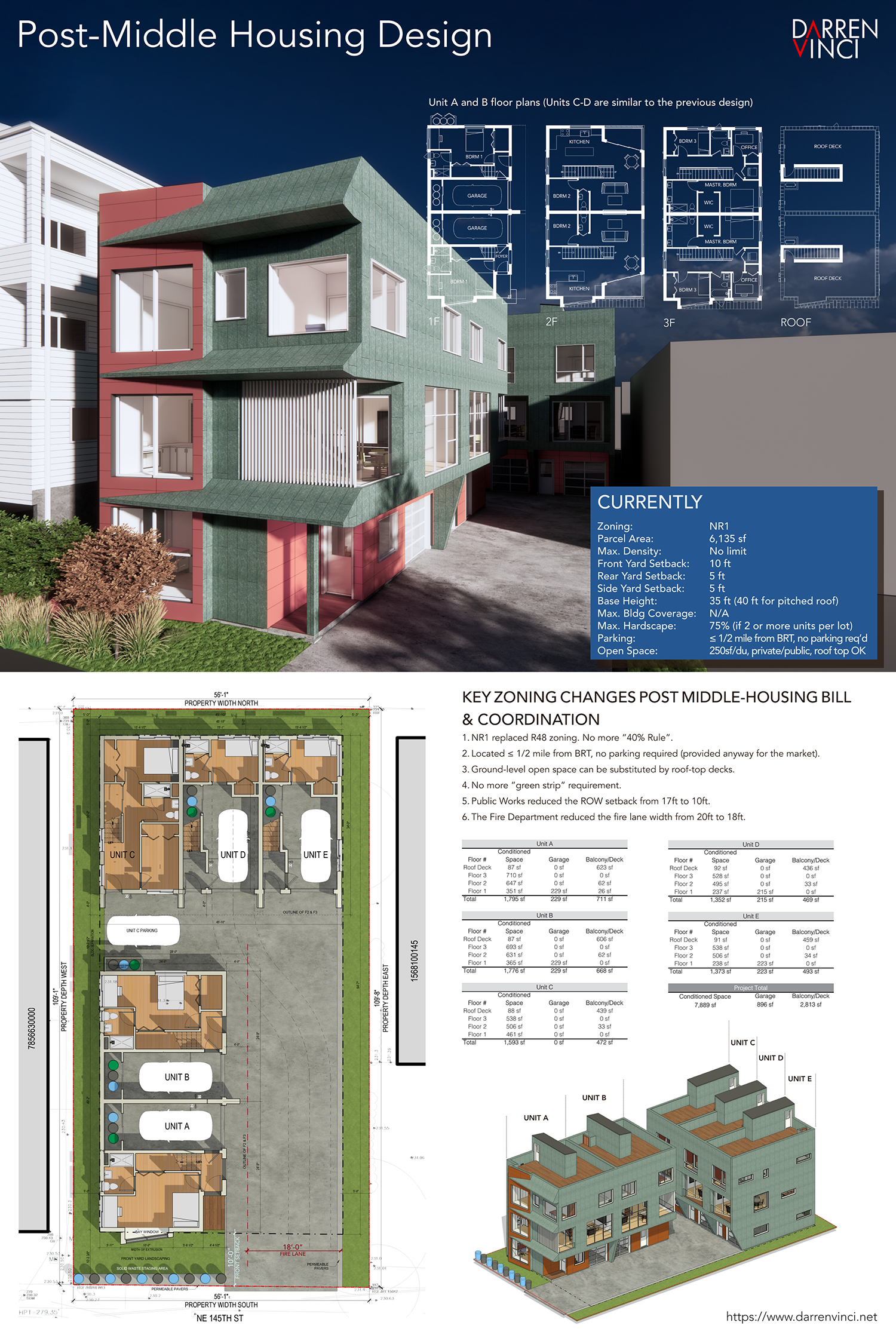
The 2025 design that meets all the current requirements.
The Turning Point: Policy Shift
Toward the end of 2024, we met with the Director and the city’s project manager. Around the same time, Shoreline adopted new zoning regulations in response to Washington State’s HB1110 Middle Housing legislation.
The regulatory landscape shifted.
Here is what changed:
The R48 zone was replaced with NR1 (Neighborhood Residential). The 40% rule was eliminated.
Projects within ½ mile of BRT no longer required parking. (We chose to provide one space per unit to meet market expectations.)
Ground-level open space could be substituted with rooftop decks.
The Planning Department removed the landscaping strip requirement.
Public Works reverted to the 10-foot front setback.
The Fire Department reduced required fire access width from 20 feet to 18 feet.
With these adjustments — and significant interdepartmental coordination — the project became viable again.
I revised the front two units to align with the west property line, creating sufficient clearance for the fire lane while maintaining a strong street presence. The new scheme increased total conditioned floor area to 7,889 square feet — 16% more than the original design.
In January 2026, the project received Administrative Design Review approval and is now ready for building permit submission.
The Real Lesson
The biggest takeaway from this experience is not about zoning math.
It is about the evolving role of the architect.
An architect today cannot function solely as a designer. We must:
Advocate for our clients
Speak publicly when regulations conflict with policy goals
Understand code well enough to challenge its internal contradictions
Negotiate across departments
Recognize moments when policy shifts create opportunity
Architecture school does not train you to stand in front of a planning commission. It does not train you to read political momentum or to engage bureaucratic systems strategically.
But if we want to operate beyond the role of stylist — if we want to influence housing supply, urban form, and economic feasibility — we must learn.
This will not be the last time I stand in front of a planning commission or city council.
Design excellence matters. But so does knowing when to fight for the right to build it.